
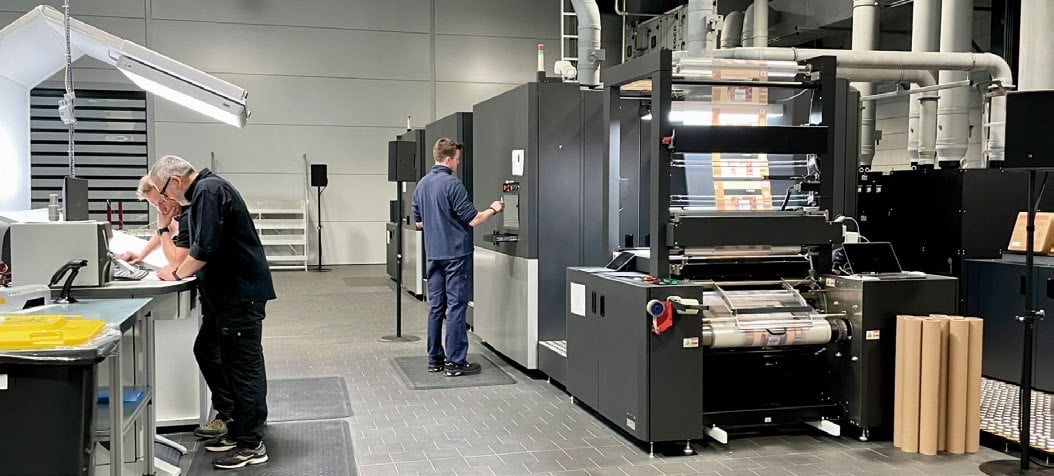
It took three months at Delo in Lohne from a visit to the British Eco Flexibles to a concrete investment decision. In January 2025, the time had come: Dettmer Verpackungen became the first German company to commission the Fujifilm Jet Press FP790, a digital inkjet web press for flexible packaging. An article by Bernhard Niemela, VerpackungsDruck & Converting
Since then, the machine has been running in production at Dettmer Verpackungen GmbH in Lohne (Delo). In May 2026, the company, together with Fujifilm, invited guests to a one-day workshop. Attendees experienced live how the FP790 works and could see how the traditional flexo printing operation is currently transforming. Why Delo made this investment decision is explained by the business reality of a large European flexo printing company.
With approximately 400 employees and currently 17 flexo presses (two more under construction), Delo is among the leading companies in the market. The machine fleet is complemented by extrusion, lamination, and converting. The customer base covers food, hygiene, household, and industrial applications. For all these applications, Managing Director Ralf Wilkens observes a trend: “Large runs remain in flexo, but smaller and customized jobs are increasingly shifting to digital printing.”
The Trend Is Clear
Ignoring this trend can result in orders either having to be declined or only being economically viable with low margins. This leaves many printers facing a familiar problem: setup costs are incurred regardless of run length.
While they are negligible for large runs, they can represent a significant portion of total costs for small lot sizes. This is where the FP790 comes in. As a water-based inkjet printing system, the machine requires no printing plate. The FP790 prints up to 790 millimeters wide, with a resolution of 1200 x 1200 dpi, and reaches speeds of up to 50 meters per minute. For Delo, the primary application is for jobs up to approximately 1,000 meters, where flexo printing is less economically viable.
Bernd Böckmann, Head of the Printing Department at Delo, comments: “We experience situations where we must deliver within two weeks. Even with in-house plate production, this is not always achievable in flexo. The FP790 gives us the necessary flexibility.”
The investment decision was well prepared. Delo’s decision-makers visited Eco Flexibles in the United Kingdom. Afterward, it was clear: the system fits Delo. “Fujifilm’s support was practical and solution-oriented,” says Wilkens. That paid off. Today, after months in production, Delo has already completed longer jobs on the FP790: jobs up to 40,000 square meters. This is remarkable considering that digital systems traditionally had their limit at four to five thousand square meters.
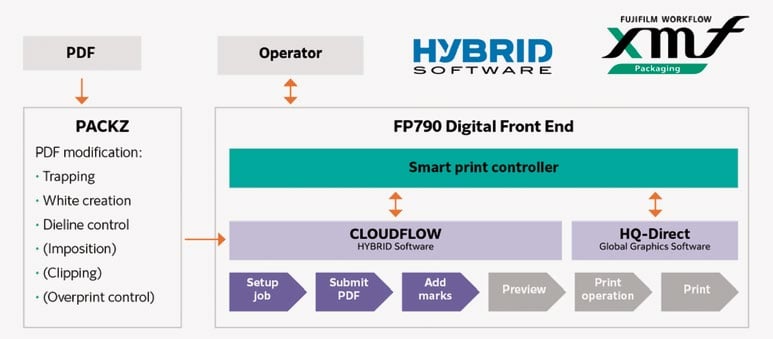
The Digital Front End XMF Packaging from HYBRID Software, developed specifically for the Jet Press FP790, automates data preparation and production control in packaging printing. At Delo, the workflow solution ensures seamless integration of the FP790 into the production process and supports short turnaround times as well as efficient processing of variable print jobs..
Not Just an “Order Expander”
However, Delo does not see the machine merely as an “order expander.” The strategic significance lies elsewhere. Wilkens: “The investment is part of a hybrid production strategy. With digital printing, small jobs can be processed economically without blocking the flexo lines.”
Specifically, this means: the FP790 relieves the flexo area and enables Delo to deploy the capacity of conventional machines more efficiently. Small jobs go to the digital printing system. Large runs are handled in flexo printing. Both processes therefore work not competitively, but complementarily.
What Plays Into Digital Printing’s Hands
This is also the argument that Manuel Schrutt from Fujifilm Graphic Systems EMEA presented at the workshop. The Head of the Packaging Division has a different perspective on the market than traditional digital press sellers. He sees the FP790 embedded in the entire production of a packaging printer. In addition to sustainability aspects (water instead of VOCs, no plates or sleeves), he also sees advantages in efficiency (no setup times) and especially in market viability. The FP790 was not built for premium niche segments. Rather, it was designed for the mainstream, meaning the volumes that run every day in flexo printing operations. Schrutt supported this with corresponding figures. A market research team from Fujifilm examined job distribution in European packaging printers. The result: most jobs fall in the range of under 15,000 square meters. The European average is therefore approximately 8,000. In this segment, digital printing was previously uneconomical. However, Fujifilm targets precisely this segment with the FP790. Ralf Wilkens from Delo confirmed this by stating: “Digital is not just a supplement, but increasingly a component of series production.”
The ecological aspect of digital printing was also emphasized at the workshop in Lohne by Ricardo Moura from the Portuguese printing company Apollo Convert (also an FP790 user): “Water-based inks, digital technology, and no waste—I needed this machine for green production.”
Regarding the market changes that play into digital printing’s hands, Manuel Schrutt explains: “Whereas there used to be perhaps 10 yogurt varieties in the supermarket, today there are more like 100. The world is becoming increasingly dynamic: there are tools like TikTok or Instagram. Brand owners post a product online there, and the next day it’s known worldwide. Under such conditions, brand owners must be able to produce packaging much faster than before. The needs and communication behavior of Generation Z are changing a lot here.”
The Flexo Printing Industry Is Challenged
Such market changes pose significant challenges for the packaging industry and therefore also shaped the discussions among packaging printers who came to Lohne from all over Europe. The workshop was moderated by Christian Menegon, an innovation expert well known in the packaging industry. At Delo, visitors could not only experience the FP790 in full production, but also follow the workflow from design concept to packaged product. Valuable information was also provided by the experience Delo has gained with the FP790 to date.
Conclusion
The flexo printing industry is challenged: by changing customer expectations, by SKU explosions (more and more variants in smaller quantities), by sustainability requirements, and regulatory pressure. An economic problem familiar to every printer is the so-called “gap” between economical flexo printing and economical digital printing. Jobs that are too small for flexo but too large for traditional digital often currently run at a loss or are not accepted at all. With the FP790, Delo was able to close this gap. This is a signal to the market. The investment shows that it is not about “flexo replacing digital” or vice versa, but about the intelligent combination of different technologies. For the participants, the workshop was a good opportunity to see how an established company pragmatically adapts its strategy.
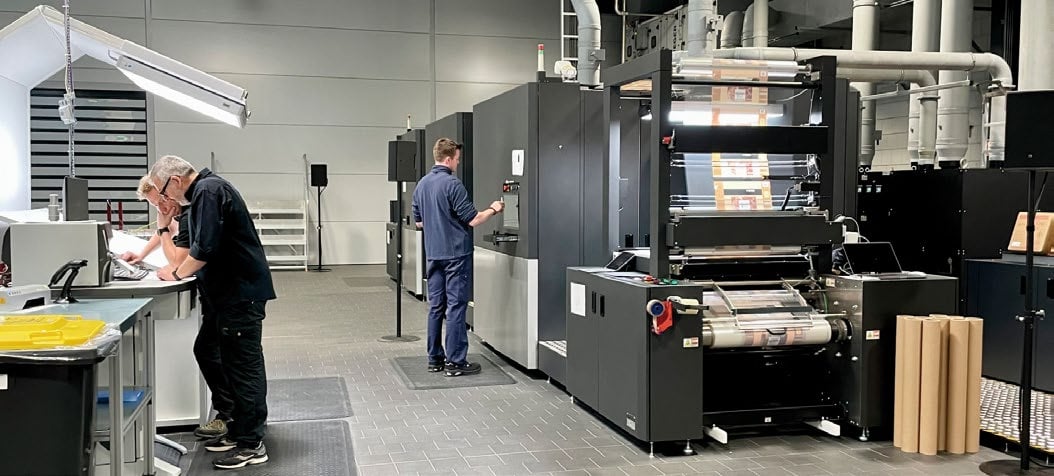
Delo in Lohne has been producing with the Fujifilm FP790 for over a year.
HYBRID Software: Workflow Specifically for Digital Packaging Printing
With the Jet Press FP790, Fujifilm relies on the Digital Front End (DFE) XMF Packaging, developed specifically for packaging printing. The workflow solution was created in close collaboration with HYBRID Software and was specifically designed for the requirements of industrial packaging production.
The web-based production workflow is based on an open, modular architecture and automates central prepress processes. This enables efficient integration of data preparation, RIP processes, and print production, contributing to shorter turnaround times and higher equipment utilization. At the same time, the open system architecture enables connection to existing MIS, ERP, and prepress systems as well as demand-driven workflow expansion.
XMF Packaging demonstrates its strengths particularly for jobs with variable data: fast RIP-&-print processing supports productive utilization of the Jet Press FP790 even with complex job structures. A practical example is the installation at packaging printer Dettmer, whose Jet Press FP790 is equipped with XMF Packaging. There, the workflow system forms the foundation for a largely automated production process and supports efficient processing of digital packaging jobs.
